Advantages of Ceramic Heaters: What to Know Before Choosing

Quick answer: ceramic heaters beat most alternatives through a combination of fast heat-up (peak in 20 minutes), a safe surface temperature of 80-90°C, energy efficiency thanks to the high thermal conductivity of ceramic, and quiet operation with an electronic thermostat. The key is to choose models with an electronic rather than a mechanical temperature control, and to pay attention to the manufacturer's warranty.
Ceramic heaters have become one of the most popular ways to heat rooms in Ukraine — and not by accident. They combine fast heating, safety for children and pets, and cost-effectiveness that stands out even more against rising gas tariffs and unstable central heating. But not all ceramic heaters are the same: the difference between a model with an electronic thermostat and a budget one with a mechanical control is noticeable both in the electricity bill and in day-to-day comfort.
In this article we break down the main advantages of ceramic heaters, what to look for when choosing one, why a ceramic element with an additional aluminum heating element is considered the optimal design for household heating, and how to avoid overpaying for features that don't actually affect comfort.
Why do ceramic heaters heat faster and more evenly?
Ceramic heaters stand out for the high thermal conductivity of their heating element: they reach operating temperature in about 20 minutes, and fully heat a room in 3-8 hours depending on the starting temperature, area, and insulation level. Ceramic distributes heat evenly across the room, avoiding the local "hot spots" typical of simple heating elements, where the air near the element gets far hotter than the rest of the room. The most efficient models are additionally equipped with an aluminum X-shaped heating element that speeds up air convection in the room and shortens the time it takes to reach a comfortable temperature.
Are ceramic heaters safe for children and pets?
Yes, provided the construction is good quality. The surface temperature of a ceramic panel is 80-90°C, but due to the low thermal conductivity of the ceramic itself, it feels like around 50°C to the touch — this reduces the risk of burns compared to metal heating elements, whose surface can be significantly hotter to the touch. Quality models are also equipped with automatic shutoff on overheating and on accidental tip-over, which significantly reduces fire risk in a room with small children or pets.
Can a ceramic heater be left unattended?
Models with certified overheat and tip-over protection are designed for long continuous operation, including at night or in an empty room during the day. But as with any electrical appliance, it's worth periodically checking the condition of the power cord and outlet, especially if the heater runs continuously throughout the entire heating season.
Energy efficiency: the main advantage
Ceramic heaters are considered among the most energy-efficient options on the household heating market. Ceramic-based heating technology provides higher efficiency in converting electricity into heat compared to simple convectors — meaning fewer kilowatt-hours are spent reaching a comfortable temperature. Energy efficiency, rather than design or price, is most often the deciding factor when choosing a heater for constant winter use, when the unit runs for several hours every day throughout the season.
| Parameter | Ceramic heater (electronic thermostat) | Cheap convector (mechanical thermostat) |
|---|---|---|
| Temperature-holding accuracy | High, smooth regulation | Low, cyclical relay clicking |
| Noise level during operation | Silent operation | Constant thermostat clicking |
| Approximate price difference | +UAH 400-500 for the programmer | Base price, roughly 20% cheaper |
| Comfort at night | Doesn't disturb sleep | Clicking is especially noticeable at night |
| Heat distribution in the room | Even, no "hot spots" | Uneven, depends on air circulation |
Portability, quiet operation, and extra features
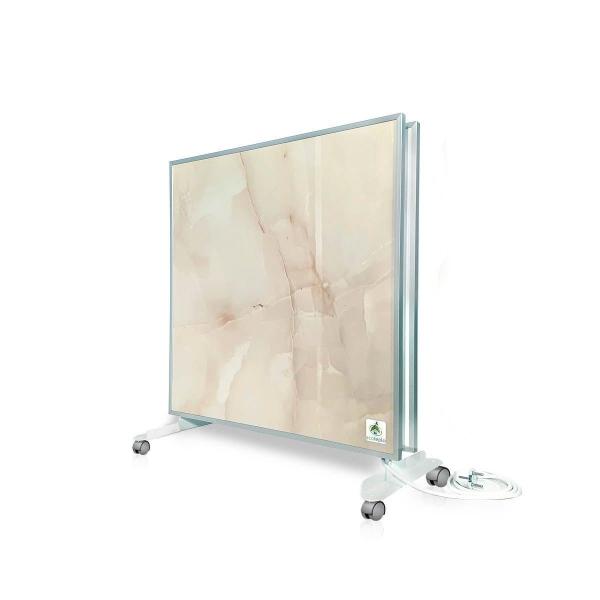
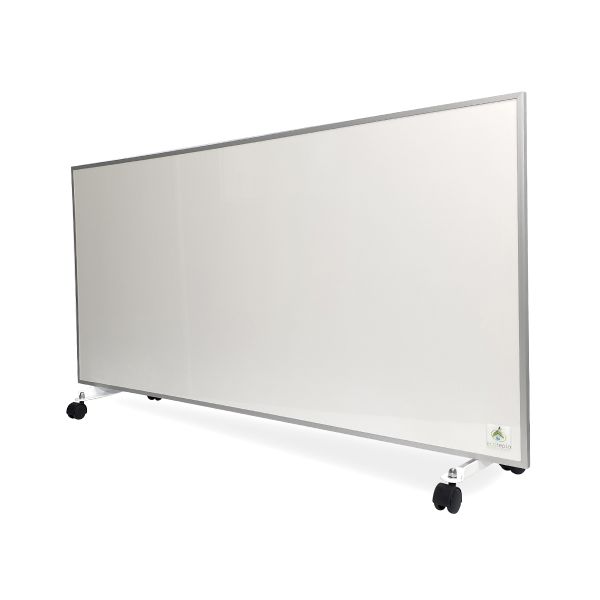
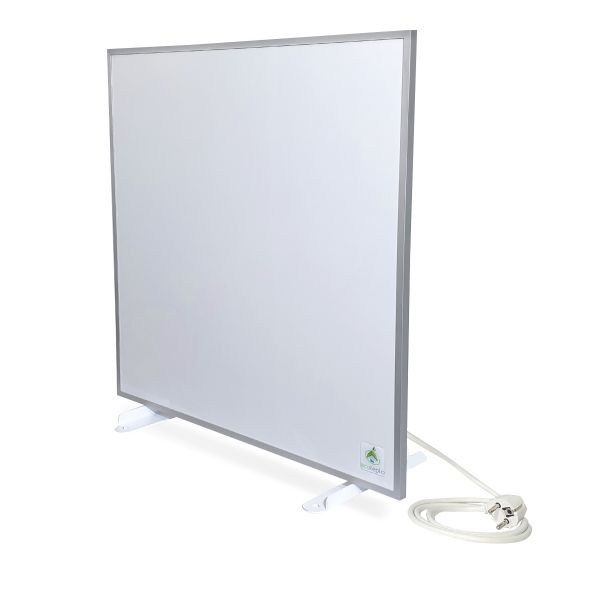
- Portability — a compact design on legs makes it easy to move the heater between rooms during the day, with no need for permanent mounting.
- Quiet operation — applies exclusively to models with an electronic thermostat; mechanical controls click constantly, which is especially noticeable and annoying at night or while working or studying at home.
- Thermostat and timer — automatically maintain the set temperature without constant user input, reducing unnecessary electricity consumption.
- Weekly programmer — lets you set the heater's operating schedule for each day of the week separately; models with a programmer are the most economical, since they eliminate unnecessary electricity use while no one is home, for example during the workday.
- Modern design — ceramic panels come in various colors and shapes, so they blend easily into an interior and don't look like a "technical" appliance.
What experience shows: reviews and typical use scenarios
Based on observations of ceramic panels in operation across different rooms, several practical patterns stand out that are worth considering at the model-selection stage:
- In a bedroom, models with an electronic thermostat and a night mode work best — mechanical counterparts disturb sleep due to constant relay clicking throughout the night.
- In a children's room, safe surface temperature and tip-over protection are critical — this is a standard feature of quality ECOTEPLO ceramic panels, not a paid add-on.
- In rooms with irregular occupancy (hallway, workshop, garage), using a timer instead of round-the-clock operation is justified — this noticeably reduces monthly electricity consumption without losing comfort when it's needed.
- In a living room with a large glazed area, plan for a power margin and consider a model with an X-shaped heating element for faster heat-up after airing out the room.
How long do ceramic heaters last, and what affects their lifespan
The stated service life of quality ceramic panels reaches up to 30 years, but in practice actual durability depends on several factors worth considering at the model-selection stage.
- Quality of the ceramic element — dense ceramic without microcracks withstands thousands of heat-cool cycles without losing thermal conductivity.
- Thermostat type — an electronic thermostat is less prone to mechanical wear compared to mechanical relay contacts, which can burn or stick over time.
- Operating conditions — room humidity and mains voltage stability affect the lifespan of the heater's electronic components.
- Warranty service — having official service in Ukraine allows a unit to be repaired if it breaks down instead of a full replacement.
That's why a manufacturer's warranty isn't a formality — it's a real indicator of the company's confidence in its own product. Manufacturers offering only 1-2 years of warranty most often build in a shorter design lifespan for the equipment.
The consequences of choosing a cheap model without a thermostat
Heaters with a mechanical thermostat cost about 20% less upfront, but according to buyer reviews they create noticeable discomfort due to constant relay clicking, especially at night. In addition, the coarse temperature control step (heating past the set level, then switching off completely) leads to more electricity consumption compared to the smooth regulation of an electronic thermostat. As a result, upfront savings often turn into overpaying for electricity during the season, which over time exceeds the price difference between the models.
Another common mistake is choosing a heater purely by power rating without considering the control type. Two units with identical power can differ significantly in actual monthly electricity consumption depending on thermostat accuracy and the presence of a programmer.
Ceramic panels during power outages
In 2026, choosing a heater is rarely limited to comfort and savings alone — how well the unit fits the realities of an unstable power supply matters a lot too. Low-power ceramic heaters (350-600 W) work well when connected through a compact UPS or power bank, providing several hours of standalone heat in one room during a short outage.
For longer outages, calculate in advance how many heaters and what combined power your generator can supply at once, and avoid overloading it by trying to heat the whole house at the same time. It's more rational to focus on one or two of the most important rooms — the bedroom or the children's room — and ensure stable warmth there. For more on choosing equipment for such scenarios, see ceramic heater and UPS during a blackout.
Ceramic panels vs. other heater types
To evaluate the advantages of ceramic heaters objectively, it's worth comparing them to the most common alternatives on the market.
| Criterion | Ceramic heater | Oil radiator | Fan heater (heat gun) |
|---|---|---|---|
| Room heat-up speed | Moderate, even distribution | Slow due to the oil's thermal inertia | Very fast, but uneven |
| Surface safety | 80-90°C, feels like ~50°C to the touch | Can get very hot at the edges | Risk of over-drying the air and burns from the hot air stream |
| Noise level | Silent with an electronic thermostat | Silent | Noticeable fan noise |
| Energy efficiency | High | Medium, slow thermostat response | Low with prolonged use |
How to choose the power of a ceramic heater for a specific room
Besides the advantages of the technology itself, it's important to choose the right power — even the best ceramic element won't provide comfort in a room twice the size it's rated for.
- For a room up to 10 m², a model with 400-600 W is usually enough with standard insulation.
- For a room of 10-20 m², consider heaters with 700-1000 W.
- For spacious living rooms of 20-30 m², models with 1000-1500 W or a combination of two lower-power units are optimal.
- For rooms with poor insulation, plan for a 15-20% power margin above the base calculation.
Ready-made options for different areas are easy to pick straight from the catalog: heaters up to 10 m², up to 18 m², and up to 30 m².
Common mistakes when choosing a ceramic heater
Based on customer consultation experience, several recurring mistakes come up most often, and they're easy to avoid once you know about them:
- Choosing by price alone — the cheapest model on the shelf often has a mechanical thermostat and a lower-quality ceramic element, which affects comfort and electricity consumption throughout the season.
- Underestimating the required power — a heater rated for a smaller area than the actual room will constantly run at its limit, unable to hold heat efficiently.
- Ignoring warranty terms — a short manufacturer's warranty often signals less reliable components inside the unit.
- Buying a heater without considering the use scenario — a model without a programmer for a room used only in the evenings leads to unnecessary electricity consumption during the day.
Sources and useful links
- Safety requirements for household heating appliances — DSTU EN 60335-2-30 "Household and similar electrical appliances... Part 2-30: Particular requirements for room heaters."
- More on choosing heater power: How to choose a heater: types, advantages, and disadvantages of devices.
- Comparison with other heater types: ECOTEPLO vs. oil radiators and Ceramic heaters with convection: what are the advantages.
Ceramic heaters offer a combination of fast heating, safety, energy efficiency, and quiet operation that's hard to find in other types of household heating. When choosing one, pay attention not just to power, but also to the thermostat type, the presence of a programmer, and the manufacturer's warranty — these are the details that determine real comfort and savings throughout the heating season. Manufacturers like ECOTEPLO offer up to 6 years of warranty on ceramic panels, which is a good quality benchmark when choosing a model for home or office, and the range of models in the up to 10 m² and up to 30 m² categories makes it easy to find the right option for a specific room size.

-
Why are ceramic heaters considered energy-efficient?
Ceramic has high thermal conductivity and provides efficient conversion of electricity into heat, so fewer kilowatt-hours are needed to reach a comfortable temperature compared to simple convectors.
-
How long does it take a ceramic heater to warm up a room?
The heater reaches operating temperature in about 20 minutes, while fully heating a room takes 3 to 8 hours depending on the starting temperature, area, and insulation.
-
Are ceramic heaters safe for small children?
Yes, provided the construction is good quality: a surface temperature of 80-90°C feels like around 50°C to the touch due to the low thermal conductivity of ceramic, and automatic shutoff on overheating or tip-over reduces the risks.
-
Why is a mechanical thermostat worse than an electronic one?
A mechanical thermostat works in "heat past the set level, then switch off completely" cycles, causing constant relay clicking and less precise temperature control, and therefore more electricity consumption compared to smooth electronic regulation.
-
Is it worth paying extra for a heater with a programmer?
Yes, models with a weekly programmer usually cost UAH 400-500 more, but they prevent the heater from running while no one is home, making them the most economical option long term.
-
What is the difference between a ceramic heater and an infrared heater?
A ceramic heater mainly heats the air through convection from the heated element, while an infrared heater transfers heat directly to objects and people through radiation. Many modern models combine both principles.
-
Do ceramic heaters make noise during operation?
Models with an electronic thermostat run practically silently. Cheaper models with a mechanical thermostat make a characteristic click with every relay on-off cycle, which is especially noticeable at night.
-
What warranty is typically offered on ceramic heaters?
Reliable manufacturers, including ECOTEPLO, offer up to 6 years of official warranty on ceramic panels, which is a good benchmark when choosing a model for long-term use.
-
Can a ceramic heater be moved between rooms?
Yes, most models have a compact design on legs, making it easy to move the unit from one room to another during the day without any extra installation.
-
What is an aluminum X-shaped heating element?
This is an additional element in some ceramic heater models that speeds up air convection in the room, improving the speed and evenness of heating compared to heaters without it.
-
Do ceramic heaters save money compared to gas heating?
Thanks to higher efficiency in converting electricity to heat and precise thermostatic control, ceramic panels can reduce heating costs for individual rooms compared to heating the whole house with gas, especially with targeted use.
-
What should you look for when choosing a ceramic heater for an office?
For an office, choose models with an electronic thermostat for quiet operation, and pay attention to power rating matching the room size and the presence of a programmer for automatic shutoff outside working hours.