Heater or Air Conditioner: Which Is Cheaper in Winter in Ukraine

Quick answer: above -5°C, an inverter air conditioner in heating mode really is more economical than direct electric heating, because it moves heat rather than generating it. But in a Ukrainian winter, when the thermometer drops to -10...-15°C and below, the air conditioner's efficiency drops sharply, while a ceramic heater delivers a steady heat output regardless of the frost. For heating 1-2 rooms as the main heat source in an Ukrainian winter, a ceramic heater most often turns out to be the more predictable and practical option.
The question "heater or air conditioner" usually comes up for the same kind of owner: the air conditioner has already been on the wall since summer, and they want to know whether it's worth switching it to heating mode instead of buying a separate appliance. There's no universal answer — it depends on the outdoor temperature, the room's area, how stable the power supply is, and whether heat is needed for a few evening hours or around the clock for the whole season.
This article looks at exactly how an air conditioner and a ceramic heater turn electricity into heat, compares real costs using an 18 m² room as an example, and explains why, in frosty conditions and with power-outage schedules, ceramic panels often win even where an air conditioner looks cheaper on paper.
How an air conditioner heats in winter, and where its efficiency limit lies
What COP is and why it drops in winter
An air conditioner in heating mode works as a heat pump: it doesn't convert electricity into heat directly but "pumps" heat from the cold outdoor air into the room. The efficiency of this process is measured by the COP (Coefficient of Performance) — how many units of heat the appliance delivers per unit of electricity consumed. At +5...+7°C outside, a decent inverter air conditioner can have a COP of 3-4, meaning that for every 1 kWh of electricity consumed, it delivers 3-4 kWh of heat.
The problem is that as the outdoor temperature drops, COP falls non-linearly. Already at -5...-7°C, a typical household air conditioner delivers noticeably less heat per kWh consumed, and at -10...-15°C the efficiency of many household split systems approaches that of an ordinary resistive heater — that is, COP tends toward 1. On top of that, the appliance spends part of its energy and time on outdoor unit defrost cycles, during which it may blow cool air into the room for several minutes.
When an air conditioner in heating mode is genuinely worthwhile
An air conditioner makes sense as the primary heat source during transitional periods — September-October and March-April, when it's +3...+10°C outside — as well as in regions and rooms where winter frosts rarely drop below -5°C. For short-term temperature maintenance in mild weather, it really is an economical option.
Another technical detail often overlooked when choosing an air conditioner specifically for winter heating is whether it has a compressor crankcase heater. Without one, the oil in the compressor thickens in the cold, and the unit can fail after just its first season of intensive winter operation. This feature is worth checking separately in the model's specifications — not even every inverter air conditioner comes with a factory crankcase heater.
How a ceramic heater heats, and what its running costs depend on
A ceramic heater is a resistive appliance: it converts electricity into heat with a coefficient close to 1, regardless of the outdoor temperature. The panel heats up and releases heat in two forms — convection (heating the air) and radiation (infrared heat warms walls, furniture, and people). This gives a more consistent feeling of comfort even at a slightly lower room air temperature.
Power, thermostat, and the panel's heat capacity
A ceramic heater's real running costs depend not on the frost outside but on three factors: power correctly matched to the room's area, whether it has a thermostat (which switches the appliance off once the set temperature is reached and holds it with minimal fluctuation), and the heat capacity of the ceramic panel itself, which keeps releasing heat for a while after the heating element switches off. This is the fundamental difference from an air conditioner: a heater doesn't lose efficiency in the cold — on the contrary, it remains the only stable heat source once heat-pump systems are already working at their limit.
Comparison table: air conditioner versus ceramic heater
| Criterion | Inverter air conditioner (heating) | Ceramic heater |
|---|---|---|
| Efficiency at +5°C | High (COP 3-4) | Stable (COP ≈ 1) |
| Efficiency at -10°C and below | Drops sharply, close to 1 | Unchanged |
| Equipment cost | Higher, requires installation | Lower, plugs into an outlet |
| Operation during power outages | The compressor draws a significant startup current, harder to power from a generator/UPS | A simple resistive load, easier to match to a generator/UPS |
| Maintenance | Filter cleaning, refrigerant top-up, servicing | Wiping dust off the panel |
| Noise | Both the outdoor and indoor units run | Silent (no fan in ceramic panels) |
| Sense of warmth | Warm air | Air + infrared radiation |
How much it costs to heat an 18 m² room per month: a sample calculation
Take an 18 m² room and two scenarios — a mild autumn (+5°C daily average) and a real winter (-8...-10°C). In mild weather, an air conditioner with a COP of about 3 can cover the heat demand while consuming roughly 0.3-0.4 kW of electricity per kilowatt of heat — that's genuinely worthwhile. But as soon as the temperature drops to typical December-February values, COP falls to 1-1.3, and the cost difference with a 1000-1500 W ceramic heater with a thermostat practically disappears — and the ceramic panel often turns out even cheaper, thanks to precisely holding the set temperature without defrost cycles.
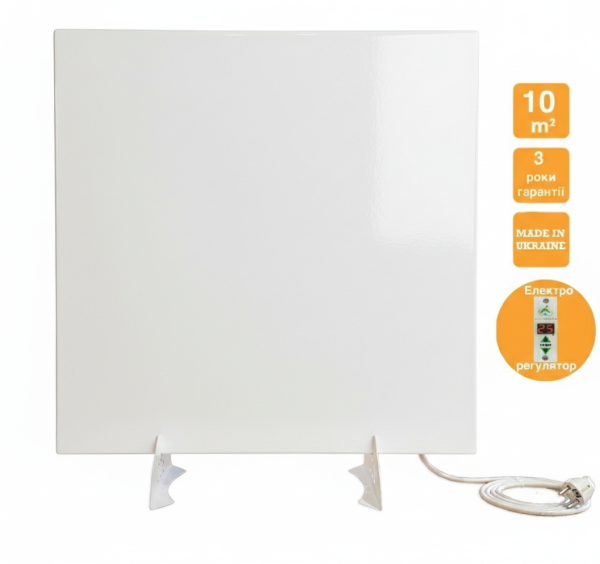
- For a room up to 10 m², the optimal model is from the heaters up to 10 m² lineup.
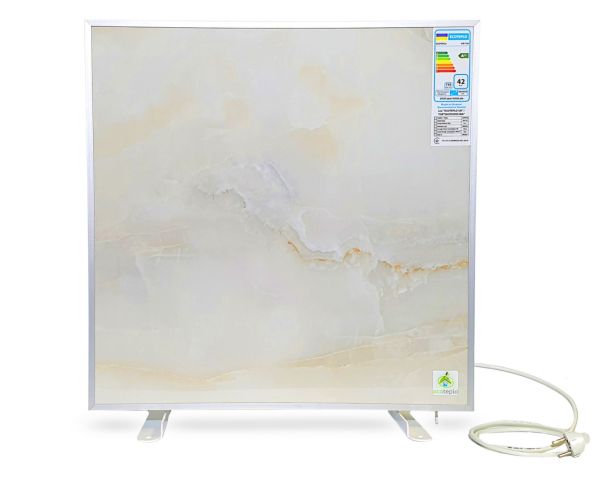
- For a 14-20 m² room, consider the heaters up to 20 m².
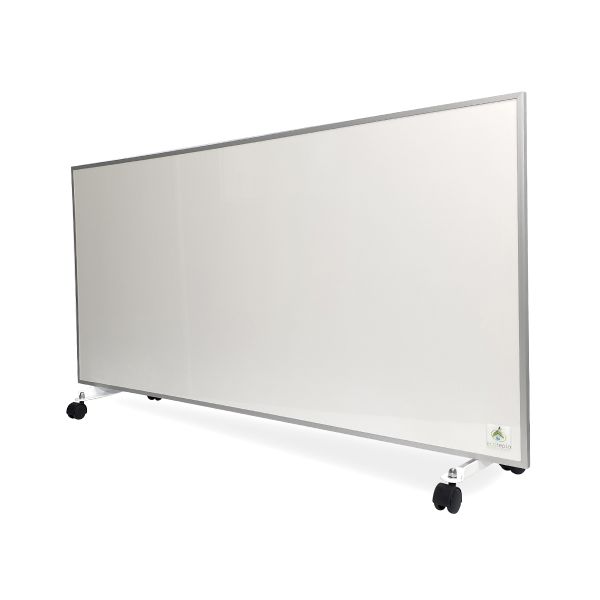
- For a large living room or studio up to 30 m², models from the heaters up to 30 m² category are a good fit.
Practical experience: what real-world usage scenarios show
In practice, owners who tried covering winter heating solely with an air conditioner most often run into two problems: in severe frost the appliance stops coping and runs with almost no economic benefit, and during power outages a powerful compressor is hard to match with a household generator or UPS because of its high startup current. In such a scenario, a ceramic heater more often serves as the backup or primary heat source — it's easier to connect even to a mid-power generator, and its thermostat holds the set temperature without sharp consumption spikes.
The most balanced approach households actually use: the air conditioner handles cooling in summer and mild heating in the shoulder seasons, while the ceramic heater provides reliable warmth in winter and during power interruptions.
Why the wrong choice ends up costing more
If you rely solely on an air conditioner in winter, the risk is that during the coldest weeks — precisely when heat demand is highest — the equipment's efficiency is at its lowest. That means the most electricity gets used exactly when savings matter most. In addition, operating a household air conditioner at extremely low temperatures outside the manufacturer's stated range shortens the compressor's service life. A ceramic heater is more predictable in this respect: its rated specifications don't change with the weather, and its service life is determined mainly by the quality of the heating element and panel.
Installation cost: which is cheaper to set up
Besides running costs, it's worth considering the starting investment: a split system requires professional installation with wall drilling, pipe routing, and vacuum-testing the circuit — a separate expense and a wait for a technician. A ceramic heater is ready to work right out of the box: wall-mounted on anchors or set up on legs, plugged into an ordinary outlet. For rented housing or a temporary solution, this is a real advantage — a heater can be taken along when you move, which can't be said of a built-in air conditioner.
Effect on humidity and air quality
An air conditioner in heating mode runs through the same circuit as in cooling mode, and condensation on the heat exchanger can somewhat lower indoor air humidity during prolonged operation. A ceramic heater doesn't draw moisture from the air as actively, since it doesn't push a large volume of air through a cold circuit — something often noted by people prone to dry mucous membranes or allergies.
Case study: a 50 m² apartment with two heating scenarios
Consider a hypothetical 50 m² apartment with a 20 m² living room and two bedrooms of 12-14 m² each. If the owner installs a single powerful air conditioner in the living room, sized "for the whole apartment," in winter frosts the bedrooms stay underheated because warm air doesn't have time to spread through all the rooms via open doors, and the air conditioner itself runs at the edge of its efficiency. An alternative approach — one ceramic heater in each bedroom (700-1000 W) plus an air conditioner or an additional heater in the living room — gives more precise temperature control in each room individually and allows heating to be switched off in rooms currently unoccupied, which in practice is more economical than trying to heat the whole apartment with one powerful source.
Common mistakes when choosing between a heater and an air conditioner
- Relying on the air conditioner as the sole heat source for the entire winter without accounting for the COP drop in frost.
- Ignoring the compressor's startup current when planning generator or UPS power for outages.
- Choosing a heater without a thermostat "to save money" — this leads to wasted electricity and uneven room temperature.
- Trying to cover heating for several rooms on different sides of the apartment with a single appliance, regardless of type.
Frequently asked questions about combining appliances
Can an old non-inverter air conditioner be used for heating
Technically yes, but non-inverter (ordinary "on/off") models have a lower base COP even in mild weather and barely hold a stable temperature — the compressor switches on at full power and off completely, instead of smoothly modulating power the way inverter models do. For winter, such an appliance is usually economically unviable even compared to a simple resistive heater.
Should you wait for warmer weather or switch to a heater right away
If the forecast shows sustained frost for the coming weeks, there's no point continuing to heat with an air conditioner at the edge of its capability — it's both more expensive and less comfortable due to defrost cycles. It's more rational to switch to a ceramic heater right away and go back to the air conditioner once the temperature stabilizes above the point where its efficiency is worthwhile again.
Long-term economics: what's cheaper over 5 years of use
Looking at a horizon of several heating seasons, it's worth factoring in not just electricity costs but servicing too. An air conditioner needs periodic filter cleaning, refrigerant level checks, and, if needed, a circuit top-up — additional expenses every few years. A solid-state ceramic heater has practically no consumables to maintain: the panel is simply wiped down periodically. With roughly equal winter electricity costs, this makes the total cost of ownership of a ceramic heater lower, or at least more predictable, over several years, since there's no risk of unexpected compressor repair or refrigerant top-up costs.
What to consider when choosing a specific heater model
Once the decision favors a ceramic heater, the next step is not to get the specific model wrong. Besides power, it's worth checking for a mechanical or electronic thermostat (electronic is usually more precise), the mounting type (wall-mounted or on legs, depending on whether mobility is planned), and the housing's protection rating if the heater will be used in humid spaces like a veranda or workshop.
Sources and useful links
- DBN V.2.5-67:2013 "Heating, Ventilation and Air Conditioning" — requirements for residential heating systems.
- Catalog of ECOTEPLO ceramic heaters — technical specifications for models across different room sizes.
- Article "How Much Does Home Heating Cost: Firewood, Gas, Diesel, or Electricity" — a comparison with other fuel types.
To sum up: an air conditioner and a ceramic heater aren't competitors — they're appliances for different scenarios. If you need reliable, predictable warmth throughout the winter, especially during frosts and possible power outages, a ceramic heater remains the more practical base solution, while the air conditioner can be used as an additional source during milder periods of the year.

-
Which is more economical in winter: a heater or an air conditioner?
Below -7...-10°C, an air conditioner's heating efficiency drops, and the cost difference with a ceramic heater practically disappears. In mild weather (+5°C and above), an air conditioner really is more economical thanks to its high COP.
-
Can an apartment be heated with only an air conditioner in winter?
Technically yes, but in severe frost efficiency drops sharply, and the compressor's startup is hard to reconcile with a generator or UPS during power outages. A ceramic heater is more reliable as the primary winter heat source.
-
What is an air conditioner's COP, and why does it matter?
COP is a coefficient showing how much heat the air conditioner delivers per 1 kWh of electricity consumed. The lower the outdoor temperature, the lower the COP, meaning the appliance runs less efficiently.
-
Why does an air conditioner periodically blow cold air in winter?
This is the outdoor unit's defrost cycle — for a few minutes the appliance stops heating and may even blow cool air while ice melts off the heat exchanger.
-
Is it harmful to keep an air conditioner running in severe frost?
Operating outside the manufacturer's stated temperature range shortens the compressor's service life and raises the risk of breakdown, so switching to direct electric heating is recommended during severe frost.
-
How much does a ceramic heater consume per hour?
Consumption equals the appliance's rated power (for example, 700, 1000, or 1500 W), but thanks to the thermostat, the appliance runs in cycles rather than continuously, so real average daily consumption is below the rated figure.
-
Which is better for a children's room: an air conditioner or a ceramic heater?
A ceramic heater is usually safer and quieter for a nursery: no airflow drying out mucous membranes, no compressor noise, and even, gentle warmth.
-
Can an air conditioner and a ceramic heater be combined in one apartment?
Yes, this is common practice: the air conditioner handles cooling in summer and light heating in the shoulder seasons, while the ceramic heater provides reliable warmth in winter and backup during outages.
-
Does an air conditioner save electricity compared to an oil-filled radiator?
In mild weather, yes, thanks to a COP above 1. But in frost, an oil-filled radiator and an air conditioner end up costing almost the same, and a ceramic heater with a thermostat is usually more economical than both.
-
How do you size a ceramic heater to replace an air conditioner?
Approximately 60-100 W per 1 m² at standard ceiling height, adjusted for the room's insulation. The heater categories on the site are already grouped by area — up to 10, 20, and 30 m².