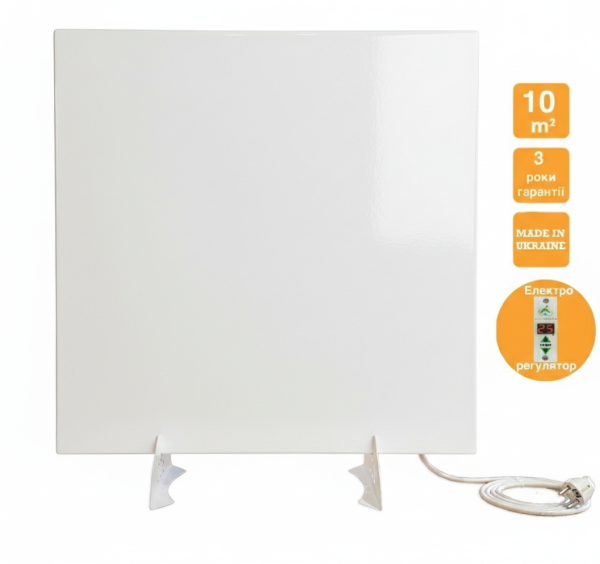
The ECOTEPLO ECO Series: Economical Heating Every Day

Quick answer: the ECO series is a line of ECOTEPLO bioconvectors with 500 W and 1200 W power ratings, designed for economical round-the-clock heating without creating cold or warm zones in a room. The series' main advantage is low energy consumption thanks to the convection-based heating principle and precise temperature control, making it a cost-effective choice for daily long-term use rather than just short-term heating.
When people think of an "economical heater," most immediately imagine a trade-off: either cheap or effective. The ECOTEPLO ECO line was created specifically to remove that dilemma — the bioconvectors are designed for long daily use with minimal electricity costs while maintaining a comfortable temperature.
Here's how the ECO series differs from other models in the ECOTEPLO lineup, who it suits, and how to use it correctly for maximum savings.
Why the "ECO" name isn't just marketing
Unlike many cases where an "ECO" label on household appliance packaging is purely a marketing device with no real technical basis, in the ECOTEPLO line the name reflects specific engineering solutions: an optimized shape for the convection channels, a precise thermostat, and a well-thought-out casing heat capacity, which together deliver lower actual electricity consumption for the same level of comfort compared to simple heating units without these optimizations.
What is a bioconvector and how does it differ from a regular panel?
A bioconvector works on the principle of natural convection: cold air enters at the bottom of the unit, passes through the heating element, and exits at the top already warm, creating natural circulation without a fan. Unlike classic infrared panels, which mainly heat objects and people within direct line of sight, a convector heats the volume of air in a room more evenly — more on the operating principle can be found in the material on what a bioconvector is.
Comparing the ECO model with ECOTEPLO's base panel lines
| Parameter | ECO series (bioconvector) | Base ceramic panels |
|---|---|---|
| Heat transfer principle | Mainly convection | Mainly radiation + convection |
| Speed of initial room heating | Moderate | Faster due to direct radiation |
| Efficiency during round-the-clock operation | High, optimized for this mode | High, versatile mode |
| Recommended scenario | Constant background heating | Primary or periodic heating |
Both approaches have their place — the choice depends on whether you plan to leave the unit on almost constantly (then ECO is the logical choice) or turn on heating occasionally when you need a fast, noticeable effect (then a panel with a stronger radiant component suits better).
ECO line specifications
| Parameter | ECO 500 W | ECO 1200 W |
|---|---|---|
| Approximate heated area | Up to 8-10 m² | Up to 18-20 m² |
| Heating type | Natural convection | Natural convection |
| Temperature control | Yes, smooth adjustment | Yes, smooth adjustment |
| Installation | Wall-mounted, simple | Wall-mounted, simple |
| Stated service life | Up to 25 years | Up to 25 years |
Why is the ECO series considered economical?
- No cold or warm zones. Natural convection distributes heat evenly across the room, so the thermostat doesn't need to constantly compensate for temperature differences at various points in the space.
- Precise regulation. The built-in thermostat maintains the set temperature, switching the unit off once it's reached instead of running constantly at full power.
- Simple installation with no extra costs. Wall mounting doesn't require complex installation work or specialists.
- Durable construction. The manufacturer's stated service life of up to 25 years lowers the long-term cost of ownership compared to units that need replacing every few seasons.
Typical ECO series use cases from customer reviews
Based on aggregated customer inquiries, the ECO series is most often chosen for three scenarios: as the main heating for a small studio apartment, as supplementary heating for a bedroom to maintain a comfortable temperature at night, and for heating a kids' room where stability and the absence of sharp temperature swings matter. In all three cases the common thread is that the unit runs for extended periods without frequent switching off, which is exactly the ideal mode for this line's bioconvectors.
Who is the ECO series for?
Which rooms suit the 500 W model?
The compact 500 W power rating works well for small rooms, bathrooms, hallways, or as an additional heat source in a room with other primary heating.
When to choose the 1200 W model?
For bedrooms, kids' rooms, and small living rooms up to 18-20 m², the 1200 W model provides primary heating without needing to buy a second unit.
What round-the-clock use shows
According to owners using the ECO series as their main heating all day, the key savings factor is a correctly set thermostat temperature (18-20°C is enough for comfort in living rooms, while every extra degree noticeably increases consumption). Owners also note that, unlike fan heaters, a bioconvector doesn't create a feeling of "stuffiness" or sharp air dryness during long operation.
A second practical point: for larger rooms, it's more effective to install two smaller panels in different zones of the room than one powerful unit in a single corner — this gives more even heating and less load on the wiring at a single point.
Installation in rented housing
For tenants, wall-mounting an ECO bioconvector is a fully reversible action: the unit is easy to remove when moving without damaging the wall (only small mounting holes remain, easily concealed). This makes the ECO series a convenient choice for those renting an apartment who want their own reliable heat source without depending on the quality of central heating in the rental or on arrangements with the owner about upgrading it.
How easy is it to replace a failed component
With the technical passport on hand and warranty terms observed, replacing the heating element or thermostat in case of a fault is usually done by the manufacturer's service center without replacing the whole unit. This is more cost-effective compared to cheap unbranded alternatives, where after a failure full unit replacement is often the only option.
How does the ECO series pair with other ECOTEPLO solutions?
For larger rooms, it makes sense to combine the ECO series with more powerful models from the heaters up to 20 m² or up to 30 m² categories, and for controlling several units at once in a private house, consider a heating-element control unit.
Can the ECO series be combined with a dual-zone night tariff
Yes, and this strengthens the ECO series' cost-saving effect even further. Thanks to the convector's heat capacity and precise thermostat, you can set a slightly higher temperature at night (when the preferential tariff applies) and rely on the room's natural heat retention plus minimal thermostat support during the day. More about registering for the preferential tariff can be found in the material on registering electric heating in Ukraine.
How much does it cost to run an ECO series heater?
A rough calculation for the 1200 W model: running with a thermostat for about 8-10 hours a day in comfort-maintenance mode (rather than continuously at full power for 24 hours), actual electricity consumption is significantly lower than the rated power multiplied by the unit's total runtime. The exact amount should be calculated using your electricity tariff and actual usage pattern, but the principle itself — a thermostat instead of manual control — is the main source of savings.
Do you need a separate thermostat, or is the built-in one enough
The built-in thermostat on ECO series models is quite sufficient for most household scenarios and requires no additional equipment. A separate programmable thermostat or smart home system can be a useful addition for those who want to automate the unit's schedule to a specific daily routine (for example, automatically lowering the temperature when everyone leaves for work), but that's a matter of convenience, not the unit's basic cost-efficiency.
How to set up the thermostat correctly for maximum savings
- Don't set the temperature "with a margin." Every extra degree above a comfortable 20-21°C noticeably increases consumption without a meaningful difference in comfort.
- Use a lower temperature at night. If the model supports programming, lower the temperature by 2-3°C during sleeping hours.
- Don't turn the unit off completely for short absences. Reheating a room from scratch often uses more energy than maintaining a moderate temperature via the thermostat.
Is the ECO series suitable for a private house?
For a small private house or country cottage, the ECO series can work as primary heating combined with several units per room, or as a supplement to gas or solid-fuel heating during the transitional season (spring/autumn), when running the main heating system isn't worthwhile due to low heat loss. For larger houses, consider combining it with more powerful models from the electric radiators up to 20 m² or up to 30 m² category.
A quick summary for choosing between ECOTEPLO series
If your top priority is minimal costs for round-the-clock heating throughout the whole season without extra features, the ECO series is the optimal choice. If additional features matter to you (Wi-Fi control, advanced schedule programming, faster heating thanks to a stronger radiant component), consider ECOTEPLO's premium lines. In both cases, the key savings factor is the thermostat and correctly sizing the power for the specific room, not the series name itself.
What comparison with other ECOTEPLO lines shows
According to customers who have used both the ECO series and the premium Terra models, the difference in comfort is mainly noticeable in additional features (Wi-Fi control, advanced programming), while basic heating efficiency is high in both cases thanks to a quality thermostat. This means that for the typical task of "economically and reliably heating a room every day," the ECO series is a fully sufficient and economically justified choice, without overpaying for features not always used in practice.
How room size affects choosing one powerful panel versus several weaker ones
For elongated or irregularly shaped rooms (such as a corner living-room-kitchen), it's often more effective to install two lower-power panels at different ends of the room than one powerful unit in one spot. This provides more even heat distribution across the whole area and reduces the temperature gap between the corner far from the unit and the one near it, which is especially noticeable in elongated rooms longer than 5-6 meters.
Why is natural convection more advantageous than forced convection for daily use?
Fan-driven heaters (fan heaters, heat guns) warm a room faster but consume extra energy running the fan itself and generate more noise during round-the-clock use. Natural convection in the ECO series has none of these drawbacks: air movement happens due to temperature differences, with no extra moving parts that could also wear out over time and require maintenance. For a unit intended for daily use throughout the whole season, this is a significant practical advantage.
How to tell that the chosen power isn't enough?
- The unit runs continuously at maximum, and the room temperature is still below comfortable.
- On frosty days the room heats up noticeably slower than in mild weather.
- The thermostat almost never switches the unit off even after reaching the set temperature of 20-21°C.
If you notice these signs, it's worth reviewing your power calculation — the room may have extra heat loss (a corner location, poorly insulated windows) that should be accounted for or offset with a second unit.
Caring for an ECO series heater for a longer service life
- Regularly clean dust from the convector's inlet and outlet vents — dust buildup reduces the efficiency of natural air circulation.
- Don't block the unit with furniture or curtains — this disrupts natural air movement and can lead to local overheating.
- Check the wall mounting's reliability once a season.
- Avoid exposing the unit to moisture if it's installed near damp areas.
Sources and useful links
Energy efficiency requirements for household electric heating appliances are set by technical regulations in the field of household appliance energy consumption. Full specifications and prices for ECO series models are available in the ECOTEPLO ceramic heaters section, and a comparison with other heater types can be found in the material on which is cheaper: round-the-clock or periodic heater operation.
The ECO series is a practical choice for those planning to use a heater daily throughout the entire heating season, not just occasionally. The combination of even convection heating, a precise thermostat, and a long stated service life makes it one of the most economically justified solutions in the ECOTEPLO lineup for continuous use.

-
What is the ECOTEPLO ECO series?
It is a line of bioconvectors with 500 W and 1200 W power ratings, designed for economical round-the-clock heating of living spaces without creating cold or warm zones.
-
Which ECO power rating to choose for a 15 m² bedroom?
For a room of this size, the 1200 W model is generally suitable, but the exact choice should be checked with a power calculator accounting for ceiling height and insulation.
-
Is the ECO series more economical than regular ceramic panels?
Cost-efficiency is determined primarily by the thermostat's precision and the usage mode, not just the type of heating element — ECO bioconvectors are optimized specifically for long daily operation.
-
How long does an ECO series heater last?
The manufacturer states a service life of up to 25 years, provided the operating rules are followed and the unit has no mechanical damage.
-
Can an ECO bioconvector be left running overnight?
Yes, with a functioning thermostat the unit safely maintains the set temperature throughout the night — more details in the material on economical nighttime heating.
-
How does a bioconvector differ from a ceramic panel?
A bioconvector mainly heats the air through natural circulation, while a ceramic panel radiates heat more directly onto people and objects in the room.
-
Is the ECO series suitable for a bathroom?
The compact 500 W model may suit as supplementary heating for a small bathroom, provided electrical safety requirements for damp rooms are followed.
-
How easy is it to install an ECO series heater yourself?
The installation is wall-mounted and requires no special skills — the unit attaches to standard brackets in 15-20 minutes.