How to Choose the Best Ceramic Heater: A Guide to Power and Safety

Quick answer: there's no single "best" ceramic heater in the abstract — there's the best heater for a specific room size, use scenario, and budget. For a 10-15 m² room, a 700-1000 W model with a thermostat and overheat protection is optimal; for a 20-30 m² living room, 1500-2000 W or a combination of two units. The main selection criteria: power matched to room area, thermal protection and tip-over shutoff, even heat distribution, and actual energy consumption rather than advertised figures.
Ukraine's heater market in 2026 is flooded with options — from budget Chinese panels at UAH 800 to premium ceramic systems with smart controls. In most cases buyers get lost not from lack of information but from contradictory information: one seller says power is what matters, another insists on the housing material, a third sells "unique technology" without a single number.
In this article we break down choosing a ceramic heater by real, measurable parameters: power relative to area, safety, energy efficiency, and practical scenarios — including how suitable a heater is for use during power outages, which for Ukrainian households in 2026 is no longer a hypothetical question but a daily reality.
What does "best" actually mean for a heater?
Before comparing models, it's worth defining the criterion. The "best" heater for an 18 m² studio with poor insulation and for a 12 m² children's room in a new building are two different units in terms of power, operating modes, and even mounting type. So the rational approach isn't to look for a "top 5 heaters" rating, but to work through three filters in sequence: required power, needed safety level, and desired features (thermostat, timer, mobile control).
Step 1: power relative to room area
The baseline guideline for rooms with a standard ceiling height (2.5-2.7 m) and normal insulation is roughly 80-100 W per 1 m². For old houses, corner rooms, or rooms with large glazed areas, this figure should be increased by 20-30%.
| Room area | Approximate power | Site category |
|---|---|---|
| up to 10 m² | 400-700 W | Heaters up to 10 m² |
| 10-18 m² | 700-1000 W | Heaters up to 18 m² |
| 15-20 m² | 1000 W | Heaters up to 20 m² |
| 20-30 m² | 1500 W | Heaters up to 30 m² |
If one unit's power isn't enough, it's smarter to place two lower-power heaters in different zones of the room than one powerful unit in a corner — heat is distributed more evenly and faster that way. A detailed calculation is given in the article "How to choose heater power by area".
Which is better — a ceramic panel or an electric radiator?
A ceramic panel heats the air and objects with infrared radiation almost instantly and works well for targeted heating of a specific zone or brief use. An electric radiator takes longer to reach operating temperature, but holds heat longer after being switched off thanks to the heat-transfer fluid in its sections. For rooms where someone spends the whole day, a combination is often more rational: a panel for quick heating in the morning, a radiator for a baseline temperature throughout the day. The range of radiators is in the up to 10 m², up to 20 m², and up to 30 m² sections.
Ceramic panel or ceramic convector: what's the difference?
Even experienced buyers confuse this. A panel works mainly through infrared radiation and heats objects and people within its direct line of sight; a convector relies on natural air convection and heats the whole room volume more evenly, but more slowly. For a room with a high ceiling or drafts, convection loses out; for a specific workstation, a panel wins. The comparison of approaches is covered in "Ceramic heaters with convection: what are the advantages" and "Which is better: a ceramic panel or a ceramic convector".
Step 2: safety — where you can't cut corners
- Overheat protection — automatic shutoff of the heating element when the housing reaches a critical temperature.
- Tip-over shutoff — mandatory for units standing on the floor or on a stand, especially in rooms with children or pets.
- Housing protection class — bathrooms and damp rooms require protection of at least IP24.
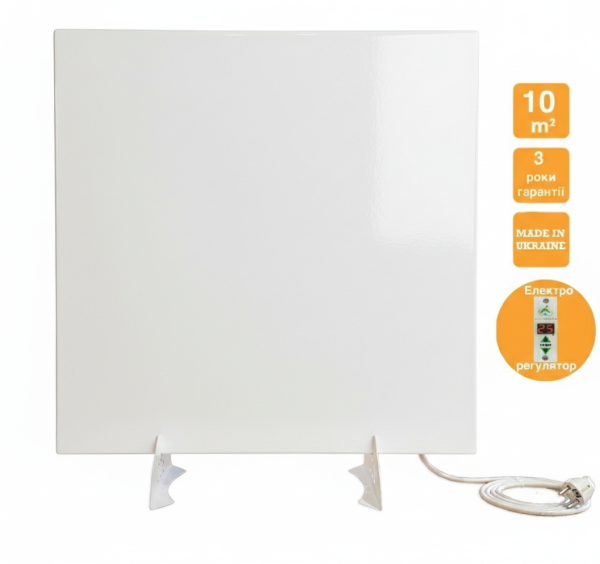
- Cool-touch housing or surface temperature limiter — ECOTEPLO ceramic panels are designed so the outer surface doesn't exceed a safe-to-touch temperature.
- Certification and labeling — a compliance mark and a technical data sheet with stated consumption parameters.
The full list of typical mistakes buyers make specifically at the safety and power assessment stage is covered in "Top mistakes when choosing a household heater".
What experience shows: real-world selection scenarios
Based on observations of ECOTEPLO customer inquiries, the most common mistake is underestimating room area by 20-30% "just to be safe," which later results in either insufficient heating in freezing weather or the unit constantly running at maximum, which accelerates wear on the heating element. Experience shows: a 16 m² room with one window in a panel building is best heated by a 1000 W unit in a mode maintaining 20-21°C, rather than a 700 W unit "at the edge of its capacity" running continuously at full power.
Another practical takeaway: owners who buy a heater specifically as a backup for power outages most often choose 350-700 W models — the range that a household power bank or small generator can realistically handle without overloading the system. For more on heater compatibility with backup power, see "UPS and ceramic heater during a blackout".
Step 3: energy efficiency and real operating cost
| Parameter | What to look at |
|---|---|
| Presence of a thermostat | Reduces average consumption by 20-40% compared to running without regulation |
| Heating element efficiency class | A ceramic element has a higher electricity-to-heat conversion efficiency than an open coil |
| Timer / programmable mode | Lets you avoid keeping the unit on when the room is empty |
| Stated vs. actual power | Check the data sheet, not marketing phrases like "50% more economical" |
An approximate calculation of monthly costs for a typical room is given in "How much does heating one square meter cost", and a comparison with alternative heat sources is in "How much does heating a house cost: wood, gas, diesel, electricity".
Why does the wrong heater choice cost more than the unit itself?
An underpowered heater is forced to run continuously at maximum, which both accelerates wear on the heating element and fails to deliver the desired comfort — the room never fully reaches the stated temperature. An oversized unit for a small room, conversely, is constantly switched on and off by the thermostat, which also isn't an optimal operating mode for the electronics. Both scenarios lead to higher electricity bills and a shorter unit lifespan — meaning "savings" at the power-selection stage most often turn into extra costs by the very first heating season.
Sources and useful links
Power calculations for household electrical appliances and requirements for their safe operation in Ukrainian residential premises are based on DBN B.2.5-23 "Design of Electrical Equipment for Civil Facilities" and DSTU IEC 60335 on household appliance safety. For practical model selection, also useful are "Heater rating 2026: top models" and the summary guide "How to choose the ideal ECOTEPLO heater".
The best ceramic heater isn't the one with the loudest advertising or the highest advertised power, but the one whose parameters precisely match your room's area, real use scenario, and your family's safety requirements. Compare several models using the power table, check for thermal protection and tip-over shutoff, and only then make your decision — this approach saves both money and nerves for the whole heating season.

-
Which ceramic heater should I choose for a 15 m² room?
For a room up to 15 m² with standard insulation, the optimal power is 700-1000 W. If the room is a corner room or has a large glazed area, aim for the upper end of the range or consider a model from the heaters up to 20 m² category.
-
How does a ceramic heater differ from an oil radiator?
A ceramic heater heats up much faster and starts giving off heat within a few minutes, while an oil radiator takes 15-20 minutes to reach operating temperature. The radiator holds heat longer after being switched off. A detailed comparison is in ECOTEPLO vs. oil radiators.
-
Is it safe to keep a ceramic heater near a child's bed?
Yes, provided the model has a cool-touch housing, overheat protection, and tip-over shutoff, and the unit itself is placed a safe distance from fabrics and curtains. Recommendations for choosing one for a children's room are in "Which heater is best for a child".
-
How much electricity does a 1000 W ceramic heater use?
Running continuously at full power — about 1 kWh per hour, but with a thermostat the real average consumption is usually 20-40% lower, since the unit maintains the set temperature in cycles instead of running continuously at maximum.
-
Which is better: one powerful unit or two lower-power heaters?
For large or elongated rooms, two lower-power heaters placed in different zones often give more even heating and less thermal lag than one powerful unit in a single corner of the room.
-
Can a ceramic panel be considered a full replacement for central heating?
For a single room or as a supplement — yes, especially during the transitional season or when the central system fails. For heating a whole house continuously, this is usually not cost-effective compared to central heating; more details are in the comparison of costs for different heating types.
-
What is the difference between a ceramic panel and an infrared heater?
A ceramic panel is a type of appliance that uses, among other things, the infrared heating principle, while classic IR heaters often have an open heating element. The comparison of approaches is in ECOTEPLO vs. infrared heaters.
-
Does a heater need a separate circuit breaker in the panel?
For units over 1500-2000 W running for extended periods, a separate line with a properly rated breaker is recommended, especially with old wiring designed for a lower load.
-
What has the biggest impact on a ceramic heater's lifespan?
The biggest factors for durability are matching the unit's power to the room's area (avoiding continuous operation at maximum), regular dust cleaning, and following the manufacturer's operating instructions.
-
Can a ceramic heater be used in a bathroom?
Only models with an appropriate housing protection class (at least IP24), installed a safe distance from water sources, in line with requirements for electrical appliances in damp rooms.
-
How much does it cost to run a ceramic heater per month?
The approximate calculation depends on power, operating mode, and electricity tariff; a detailed example for a typical room is given in "How much a heater consumes per month".
-
Can a ceramic heater be connected to a generator or power bank?
Yes, 350-700 W models can usually realistically be powered from a household power bank or a small generator without overloading it. More details in "UPS and ceramic heater during a blackout".
-
Which is better for an office: a ceramic panel or a fan heater?
A ceramic panel runs quieter, doesn't over-dry the air, and is safer for continuous use throughout the workday. A fan heater warms up faster but is less suitable for constant operation near people. Comparison in ECOTEPLO vs. heat guns.
-
Is there a difference between premium and budget ceramic heaters?
The main differences are in thermostat accuracy, heating element quality, protection class, and warranty period. Premium models in the Terra line usually come with a longer warranty and more stable temperature holding.