Heater for a Children's Room: What to Look For

Quick answer: for a children's room, the safest option is a ceramic heater with an enclosed heating element, a surface temperature up to 60°C, tip-over protection and auto shut-off, sized to the specific room area (approximately 60-80 W per m² for a standard ceiling height). It doesn't burn oxygen, doesn't dry the air as much as a fan heater, and runs almost silently.
When it comes to warmth for a child, the usual criteria of "cheap" and "heats up fast" take a back seat. Safety comes first: will the child get burned touching the appliance, will the air dry out so much that coughing starts, will a lightweight housing tip over during play. In this article we'll cover which heater types suit a children's room, which are best avoided, how to calculate the right power, and what to look for when choosing a specific model.
Why choosing a heater for a child differs from choosing one for a living room
In an adult room, a surface temperature of 90-120°C is simply "hot to the touch." In a children's room this is already a burn risk, especially for children under 5-6 years old, who physically cannot pull their hand away quickly or assess the danger in advance. The second factor is air humidity: overly dry air irritates mucous membranes, raises the risk of colds, and worsens sleep. The third factor is noise: the fans in fan heaters and forced-convection heaters keep a child from falling asleep and can affect infants' sleep quality.
Which heater types are dangerous or undesirable in a nursery
- Coil and tubular-element fan heaters — an exposed coil heats up to 300-500°C, burns dust and oxygen, creates a characteristic burning smell, and hums loudly with its fan.
- Open-type halogen and quartz infrared heaters — the bright glow attracts a child's attention, and the surface can exceed 200°C.
- Oil-filled radiators without reliable thermal protection — heavy, can tip over, fin surface heats up to 90-110°C, and cool down slowly after being switched off.
- Gas and diesel heaters of any type — open combustion, combustion byproducts, absolutely not for children's rooms.
What makes a ceramic heater an acceptable solution
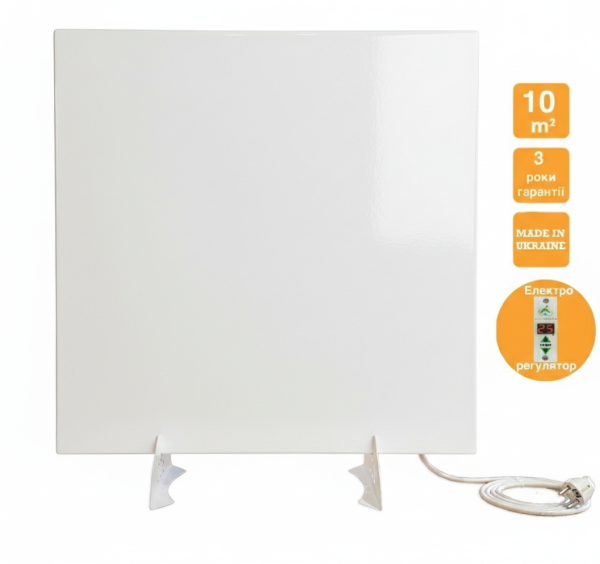
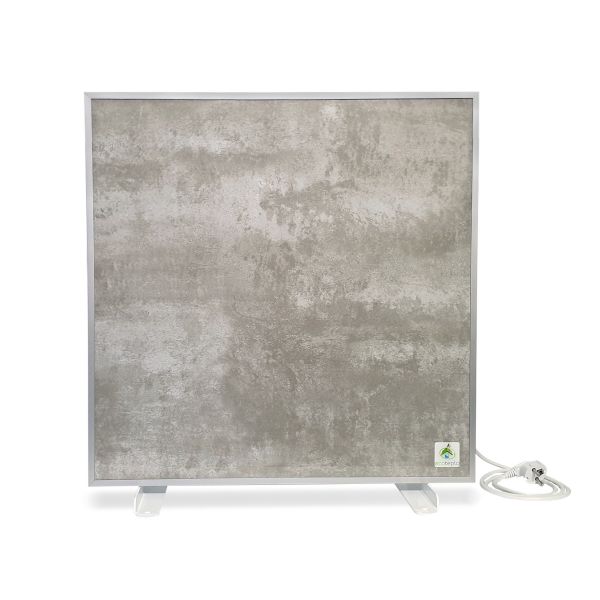
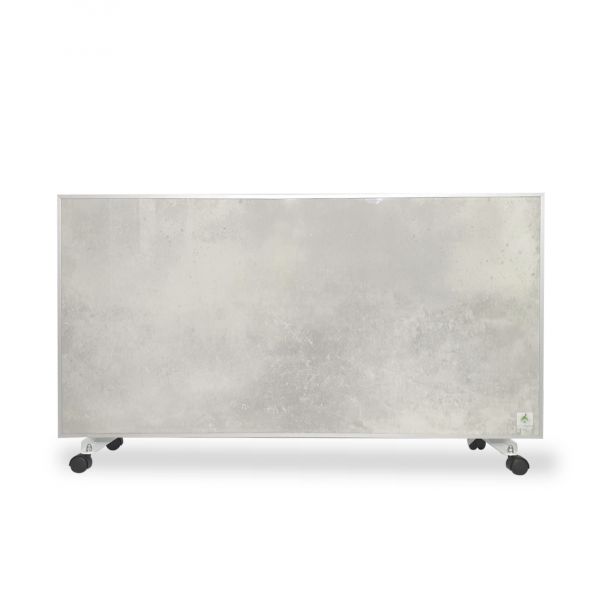
ECOTEPLO ceramic panel heaters warm the air mainly through radiation from the ceramic plate rather than a glowing coil. The panel's working surface usually doesn't exceed 60-65°C — noticeably warm to the touch, but it won't cause a burn on brief contact. There's no fan blowing dust around the room, and no burning smell that fan heaters produce after standing idle.
What to look for when choosing a model for a nursery:
- Moisture and dust protection rating — important if the room is combined with a bathroom for an infant;
- A tip-over sensor with auto shut-off;
- Overheat protection if the appliance is accidentally covered with fabric or a toy;
- Wall-mount option — keeps the appliance off the floor and out of the child's reach;
- A thermostat with a low regulation limit — to avoid over-drying the air by maintaining 20-22°C instead of a constant 25-26°C.
Wall mounting versus floor placement
For a children's room, wall mounting is almost always the better option. A panel mounted 20-30 cm above the floor or higher is physically out of a child's reach during play, and warm air rises in a natural convection flow, evenly heating the room without drafts along the floor, where a small child plays most often.
How to calculate the required power
For a children's room with a ceiling height up to 2.7 m and standard thermal insulation, the approximate calculation is 60-100 W per 1 m² of area, depending on window quality and whether the room is a corner or end room.
| Room area | Approximate power | Recommended category |
|---|---|---|
| up to 10 m² | 0.6-0.8 kW | heaters up to 10 m² |
| 10-18 m² | 0.9-1.4 kW | heaters up to 18 m² |
| 18-20 m² | 1.2-1.6 kW | heaters up to 20 m² |
A corner room with two exterior walls, or a room above an unheated basement, loses more heat — it's worth adding a 15-20% margin to the calculated power so the appliance isn't constantly running at maximum.
Practical experience: what real-world usage scenarios show
According to parents who install ceramic panels in children's rooms, the best result comes from a combination: a panel with a slight power margin plus a thermostat set to 21-22°C at night and 22-23°C during the day for active floor play. Running constantly at full power without a thermostat not only wastes extra electricity, but also dries out the air faster than cyclic operation that maintains a set temperature.
Another practical point is placing the heater at least 1 m away from the crib or playpen, even if the appliance's surface is relatively safe: a prolonged direct flow of warm air onto a sleeping child is just as undesirable as a draft from a window.
Air humidity: how to avoid over-drying the room
Any heating lowers the relative humidity of indoor air. Ceramic panels do this more moderately than convection fan heaters thanks to their predominantly radiant heating mechanism, but during the heating season it's worth additionally monitoring humidity with a hygrometer and using a humidifier if needed, especially in rooms with infants under one year old.
Optimal microclimate parameters for a children's room according to pediatric recommendations: air temperature 20-22°C, relative humidity 40-60%. Overheating a room above 24°C is just as undesirable for an infant's sleep as cold is.
Wiring and outlet safety in a children's room
Even the safest heater remains an electrical appliance, so the outlet in a children's room should have working grounding and, if possible, child-safety shutters. The appliance's cable should be routed so the child can't pull on it or trip over it — this is why wall mounting with a short, direct connection to the outlet is more practical than a floor model with a long cord running across the room.
What else to choose: accessories and control
For a children's room, it's useful to pair the heater with a remote thermostat or a smart control unit that lets you control the temperature remotely without entering the room or disturbing the child's sleep. The range of compatible heater accessories includes thermostats with different regulation ranges.
Conclusion
The optimal heater for a children's room is a ceramic panel with an enclosed heating element, wall mounting, a thermostat, and tip-over and overheat protection. Such an appliance won't burn a child on brief contact, doesn't burn oxygen, runs quietly, and allows precise temperature control without sharp swings. Before buying, be sure to calculate the power for your specific room area — both insufficient and excessive power equally worsen comfort and increase electricity costs.
Sources and useful links
- DBN V.2.5-67:2013 "Heating, Ventilation and Air Conditioning" — requirements for residential heating systems
- DSTU EN 60335-2-30 — safety requirements for household electric heaters
- Catalog of ECOTEPLO ceramic heaters to select a model for your children's room area

-
Which heater is the safest for a children's room?
The safest option is a ceramic panel with an enclosed heating element, a surface temperature up to 60-65°C, a tip-over sensor, and overheat protection. Such appliances have no exposed glowing coil and won't burn a child on brief contact.
-
Can a heater be left on in a children's room overnight?
Yes, if the appliance has a thermostat and an auto shut-off system for overheating or tipping over. It is recommended to set a lower nighttime temperature of 20-21°C and place the heater at least 1 m from the crib.
-
Do ceramic heaters dry out the air in a nursery?
Less than fan heaters or convectors with forced airflow, since the main heating mechanism is radiation rather than intense hot-air circulation. Still, any heating reduces humidity, so it is worth monitoring the microclimate with a hygrometer during the heating season.
-
What is the optimal temperature in a children's room in winter?
Pediatric recommendations are 20-22°C during the day and slightly lower, 19-20°C, during sleep. Air humidity should be maintained at 40-60%.
-
How many watts are needed for a 12 m² children's room?
Approximately 1-1.2 kW for a standard ceiling height up to 2.7 m and normal thermal insulation. For a corner room with two exterior walls, add a 15-20% power margin.
-
Is a thermostat needed for a heater in a children's room?
Yes, a thermostat maintains a stable temperature without manual control, avoids overheating the room, and reduces electricity consumption compared to constant full-power operation.
-
Is a wall-mounted or floor heater better for a nursery?
Wall mounting is safer: the appliance is out of the child's reach during floor play, and the cable connects directly to the outlet without a long cord running across the room.
-
Can a heater be placed next to a crib?
It is not recommended to place the appliance closer than 1 m to the crib or to direct the warm air flow straight at a sleeping child.
-
Why are fan heaters dangerous for a children's room?
An exposed coil heats up to several hundred degrees, burns dust, creates a burning smell after standing idle, and hums loudly, which disturbs a child's sleep.
-
Can an oil-filled radiator be used in a nursery?
Oil-filled radiators are heavy and can tip over, and the fin surface heats up to 90-110°C and stays hot for a long time even after the appliance is switched off, raising the risk of burns.