Where to Place a Ceramic Heater: Wall, Floor, or Bracket

Quick answer: for most rooms, the optimal placement is wall-mounted under a window or on the wall opposite the sofa, at a height of 15-30 cm from the floor: this way the heat flow blocks the area of greatest heat loss and warms the air evenly. Floor placement is justified when the heater needs to be moved between rooms or serves as a temporary/backup heat source during power outages.
The question of "where to put the heater" seems trivial until it turns out that a 1000 W unit in one corner of a room is barely noticeable, while the same unit moved under a window warms the room in 20-25 minutes. The difference isn't in the power — it's in the physics of convection and the placement relative to the cold source. In this article we break down when floor placement is justified, when it's worth switching to wall mounting, how to calculate a safe distance, and what to consider if the heater will run standalone during a blackout.
We draw on practical experience installing Ecoteplo ceramic panels and convectors in apartments and houses across Ukraine, as well as common mistakes that most often lead to wasted electricity or uneven heating.
Floor or wall: what the physics of heat determines
A ceramic heater warms the air near its housing, and warm air rises according to the laws of convection. If the unit stands on the floor in the middle of a room, the heat flow first rises vertically and only then spreads sideways — part of the heat is "lost" near the ceiling, without having time to warm the zone where people are.
If the same unit is mounted on the wall under a window, it acts as a barrier against the cold air sinking down from the glass — the most common cause of drafts and the feeling of "cold despite the heater being on." The heat flow from the device immediately mixes with the cold downward draft and prevents it from reaching floor level.
When is floor placement justified?
- Temporary or backup heating — for example, a heater moved into a room only in the evening or during an emergency heating outage.
- Rented housing, where drilling into walls for a bracket is prohibited or undesirable.
- Use with a UPS/power bank during a blackout — it's simpler to quickly move the unit and connect it to a standalone power source than to pre-install several wall mounting points in different rooms. For more on approaching standalone heating, see "UPS + ceramic heater during a blackout".
- Periodic furniture rearrangement or seasonal use (a cottage, garage, workshop).
When is wall mounting the better choice?
- Continuous, daily heating of a room or office — a fixed installation point gives more stable, even warming.
- There are children or pets — a unit mounted up high is out of reach of accidental touch or tipping.
- Limited floor space — studios, children's rooms, small bedrooms, where every square meter of floor counts.
- Maximum efficiency per unit of power is needed — wall placement under a window blocks the main source of heat loss.
How to correctly calculate mounting height and distance
Manufacturers of ceramic panels and convectors usually recommend mounting at 15-30 cm from the floor for convector-type units (giving warm air free access from below) and slightly higher — 30-60 cm — for panels with an infrared component, so the radiation flow covers a larger area of the room.
| Parameter | Recommended value | Why it matters |
|---|---|---|
| Distance from the floor | 15-30 cm (convector), 30-60 cm (panel) | Ensures free convection and even heat distribution |
| Distance from curtains, furniture | at least 50 cm | Prevents surface overheating and triggering the overheat protection |
| Distance from floor to outlet | per electrical code, usually at least 30 cm with no direct water contact | Electrical safety standards for residential premises |
| Distance from wet zones (bathtub, kitchen sink) | outside the splash zone, or use a model with a higher protection class | Prevents short circuits and electric shock |
What installation experience shows
In practice, the most common mistake is placing the heater in a corner of the room, further away "so it doesn't get in the way." This feels intuitively convenient, but corner placement actually gives the slowest heating: the heat flow runs into two walls at once and circulates poorly through the whole room volume. In comparative measurements in identical 16-18 m² rooms, a heater under a window brought the room to a comfortable temperature roughly 20-30% faster than the same unit in a corner — simply due to better heat flow distribution, with no difference in electricity consumption.
A second typical scenario: owners of private houses who install one powerful heater for a large open space (a living room-kitchen combo). Here it works better to use two lower-power units placed on opposite walls rather than one high-power unit at a single point — this gives more even heating across the whole area and less local overheating of the air right next to the unit. On correctly matching power to area, see "How to choose heater power by area".
Can a heater be mounted in a bathroom or kitchen?
Yes, but only a model with an appropriate moisture protection class (usually stated in the manufacturer's technical documentation) and with the installation zone respected — outside the direct splash zone and a safe distance from water sources. Household ceramic heaters without moisture protection must not be installed in a bathroom — that's a direct electric shock risk.
For a kitchen, the most practical solution is wall mounting away from the stove and sink, to avoid grease vapor and splashes reaching the unit's housing.
Practical experience: common mistakes in choosing a spot
- Installing it under an outlet reached by an extension cord across the whole room. A long extension cord for a 1000-2000 W unit adds extra load on the wiring and a risk of the cable itself overheating. A dedicated outlet within 1-1.5 m of the mounting point is optimal.
- Ignoring the door-swing direction. If the heater sits on the floor in the path of a door opening, it's both inconvenient and a tip-over risk.
- Mounting too close to the ceiling. Warm air accumulates near the ceiling, and the zone where people actually are warms more slowly — defeating the purpose of wall mounting.
- Placing it behind curtains or furniture. Blocks the convection flow and creates local overheating of the fabric — a fire hazard.
Why does placement affect electricity costs?
Correct heater placement doesn't save kilowatt-hours directly — the unit consumes as much as its power rating and thermostat dictate. But it shortens the time it takes the room to reach a comfortable temperature and reduces the number of the thermostat's "overheat-cool" cycles, and therefore the total daily runtime of the heating element. In practice this gives noticeable monthly savings, especially combined with other energy-saving techniques — more on those in "How to save electricity in winter: 15 tips".
Choosing a model for your mounting type
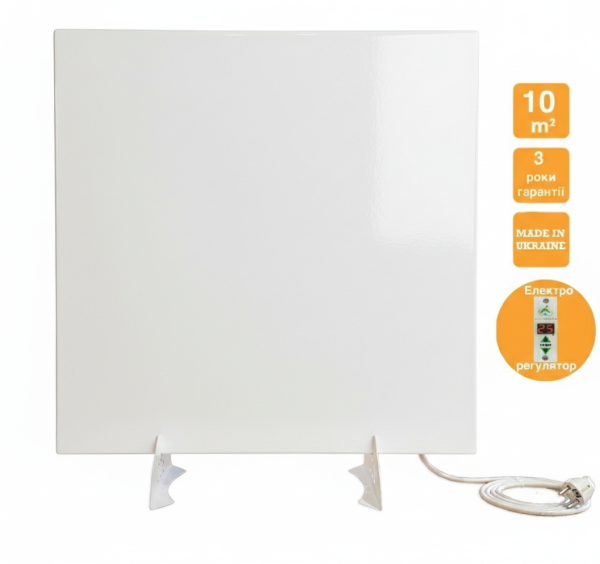
If you're planning permanent wall mounting in a room up to 10 m², compact models from the heaters up to 10 m² category will work well. For medium-sized rooms, look at the heaters up to 20 m² or up to 18 m² lines, and for large living rooms and studios, the heaters up to 30 m². For the highest level of finish and designer installation in a prominent spot, consider the Premium Terra series. Accessories for secure wall mounting — brackets, cables, protective elements — are gathered in the heater accessories section.
Sources and useful links
Requirements for placing electrical appliances relative to wet zones and outlets are based on the Electrical Installation Rules (PUE) and DBN B.2.5-23 "Design of Electrical Equipment for Civil Facilities." For practical power calculations for a specific room area, the article "Minimum power for heating an apartment" is also useful.
There's no single "correct" spot for every heater — there's the optimal solution for a specific room, use scenario, and household. If the unit runs every day for long hours, invest the time in wall mounting under a window or opposite the main seating area. If it's a backup heat source for power outages, keep it mobile, with a short path to the nearest outlet or standalone power source.

-
Can a ceramic heater be placed directly on a carpet or laminate floor?
Yes, most floor-standing ceramic heaters have heat-resistant feet and overheat protection underneath, so brief operation on a carpet or laminate floor is safe. For continuous daily use, however, it's better to use a solid heat-resistant stand and avoid placing the unit flush against thick pile carpet, which can block the air intake underneath.
-
How far from curtains can a heater be mounted?
The minimum recommended distance is 50 cm from flammable materials, including curtains, fabric lampshades, and upholstery. This is a standard requirement from most household heating appliance manufacturers and also a basic fire-safety requirement.
-
Does a wall-mounted heater need a separate breaker in the panel?
For a single household heater up to 2-2.5 kW, a separate breaker usually isn't required if the existing line and breaker are rated for that load. But if you're planning several heating points at once, or you have old wiring, consulting an electrician and adding a separate line with its own breaker if needed is a safety matter, not a preference.
-
Which is better for a child's room — a wall-mounted or floor-standing heater?
For a children's room, wall mounting at a height out of the child's reach is almost always better: it reduces the risk of burns or the unit tipping over. More on safely choosing a heater for a children's room in "Heating a children's room: safety and savings."
-
Can a heater be built into a niche or furniture enclosure?
It's not recommended. An enclosed space restricts air convection, the unit runs less efficiently, and the overheat protection may trigger more often. If aesthetics matter, it's better to choose a premium-design model for open mounting than to hide a regular heater inside an enclosure.
-
What's the maximum distance a heater can be from an outlet without an extension cord?
Technically there's no limit, but practically it's best for the unit's cable (usually 1.5-2 m) to reach the outlet without an extension cord. Using an extension cord for a high-power heating appliance is undesirable due to extra heating of the extension cord's contacts under load.
-
Does mounting height affect how fast a room heats up?
Yes. Mounting too high (close to the ceiling) slows down heating the zone where people are, since warm air accumulates up top. The optimal height of 15-30 cm from the floor for convector-type units gives the fastest, most even heating of the whole room volume.
-
Can a wall-mounted heater be moved from its bracket to the floor and back?
Yes, if the model has a removable bracket — a common feature in household ceramic panels. This gives flexibility: permanent wall mounting in winter and compact storage or moving to another room in summer or during renovations.
-
Is it safe to leave a wall-mounted heater on overnight?
Modern models with a thermostat and overheat protection are designed for extended continuous operation, including at night. The key is following the recommended distances from flammable materials and not covering the unit. Tips for economical nighttime heating are in "How to heat a room at night economically."
-
What if the wall is drywall and can't support a standard bracket?
For drywall partitions, use special toggle anchors, or mount the bracket where a metal stud or wooden frame member runs behind the drywall. If you're unsure about the mounting's reliability, it's safer to choose floor placement on a stable base.
-
Should a heater be unplugged if it's not used for a long time?
For units with good overheat protection, this isn't required for safety, but it's recommended for practical reasons — reducing unnecessary standby consumption and extending the life of the thermostat's electronic components.